
Rumi
1207–1273
Jalāl ad-Dīn Muhammad Rūmī was a 13th-century Persian poet, Islamic scholar, and Sufi mystic. His poetry has influenced the world and his Masnavi is regarded as one of the greatest works of mystical literature.
Works by Rumi
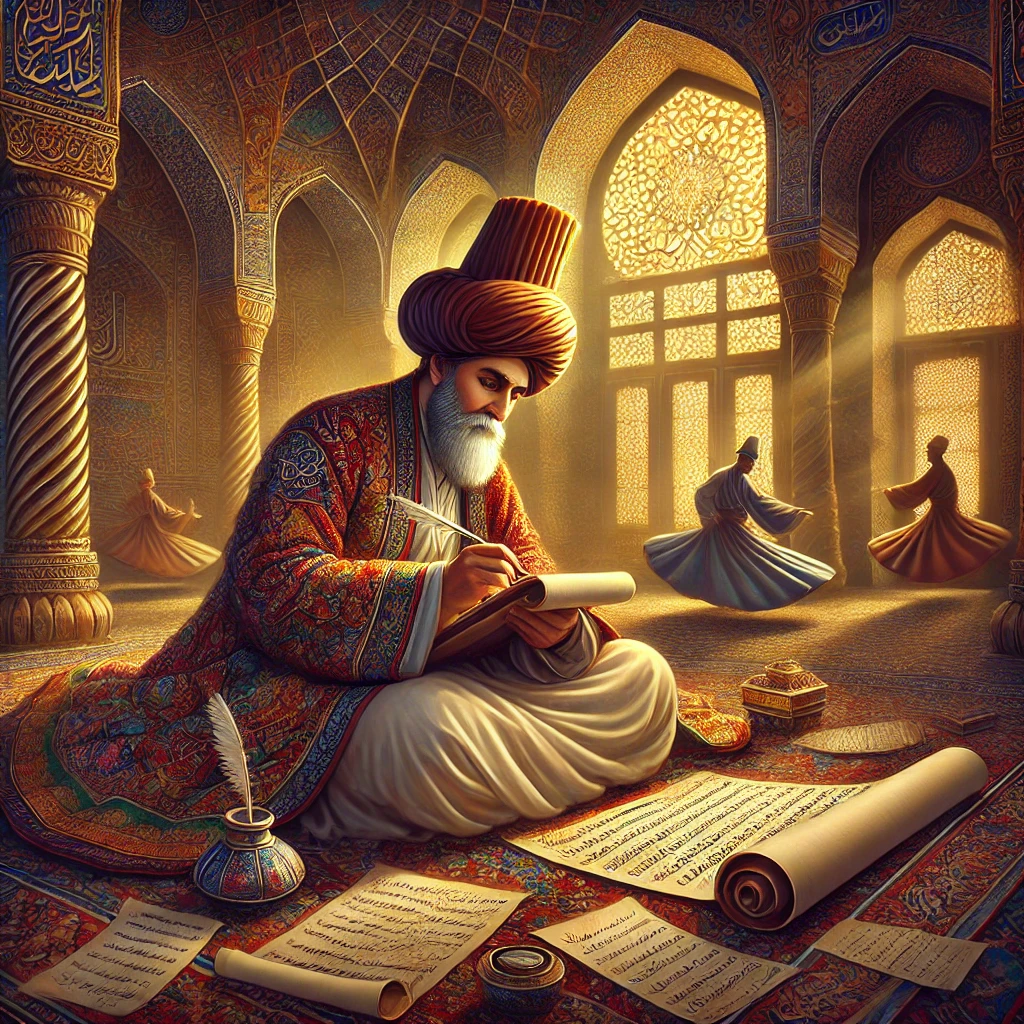
The Masnavi
The Masnavi, written by the 13th-century Persian poet and Sufi mystic Jalāl ad-Dīn Muhammad Rūmī, is a six-volume poem widely celebrated as one of the greatest works of mystical literature. Composed in rhyming couplets, it serves as a practical guide to the Sufi path, illuminating key aspects of spiritual life such as love, unity, and the journey of the soul toward God. Rumi employs fables, parables, and anecdotes that reflect both everyday experiences and deeper metaphysical truths. These stories often revolve around moral dilemmas, illustrating how struggles with ego, attachment, and ignorance can veil one from true understanding. Through vivid imagery and eloquent language, the Masnavi encourages readers to cultivate a heart-centered devotion, emphasizing self-awareness, humility, and unwavering trust in the Divine.
Read Full Text
The Masnavi: Book 1
Book One of the Masnavi opens with a prologue that sets the tone for Rumi’s profound exploration of spiritual themes. The narrative begins with the plaintive cry of the reed flute, symbolizing the soul’s longing to return to its divine source. Through a rich tapestry of allegories, parables, and anecdotes, Rumi delves into themes of love, separation, divine will, and the soul’s journey toward unity with the Beloved. Key stories, including “The Prince and the Handmaid,” “The Oilman and His Parrot,” and “The Lion and the Beasts,” highlight the complexities of human desires, the perils of pride, and the transformative power of divine love. Rumi contrasts the transient nature of worldly attachments with the eternal fulfillment found in surrender to the divine. He emphasizes self-purification, humility, and reliance on God’s will, illustrated through parables of prophets, kings, and commoners. With its blend of mystical insight and poetic beauty, Book One lays the foundation for the deeper spiritual lessons of The Masnavi, inviting readers to reflect on their own connection to the divine.
Read Full Text
The Masnavi: Book 2
Book Two of The Masnavi expands upon the mystical themes introduced in the first volume, using fables and parables to illuminate human frailties and spiritual truths. Throughout the text, Rumi underscores the tension between outward appearances and inward essence: the Sufi’s neglected donkey, for instance, highlights how inattentiveness to duty and blind imitation lead one […]
Explore
The Masnavi: Book 3
Book Three of The Masnavi weaves together a rich tapestry of parables and tales that shed light on humanity’s spiritual journey. In these verses, Rumi underscores how a seemingly worldly story—like travelers who kill a young elephant and face the parents’ vengeance—becomes an allegory for divine justice. He shows that God defends the “orphaned soul,” […]
Explore
The Masnavi: Book 4
Book four of the Masnavi opens with an address to Husamu-’d-Din and spans a series of interwoven stories teaching spiritual lessons about perseverance, humility, and divine love. The first tale depicts a lover who, after years of searching, inadvertently reunites with his long-lost mistress when forced to flee the night patrol—symbolizing how hardship can be […]
Explore
The Masnavi: Book 5
Book five of The Masnavi continues Rumi’s rich tapestry of parables illustrating spiritual truths, with a primary focus on the hidden motives behind outward acts and the transformative power of sincere faith. One central story recounts how the Prophet hosted a coarse, unbelieving guest who devoured all the family’s milk, soiled his bedding, and fled […]
Explore
The Masnavi: Book 6
Book six of The Masnavi brings Rumi’s grand spiritual epic to a thoughtful close, weaving parables and commentary into a final tapestry of mystical understanding. Running through every story is a core theme: all forms in this world are mere shadows of the Infinite Truth that lies beyond. A key narrative follows three princely brothers […]
Explore