
This alchemy may be briefly described as turning away from the world to God, and its constituents are four: The knowledge of self, The knowledge of God, The knowledge of this world as it really is, The knowledge of the next world as it really is.
Alchemy of Happiness
Al-GhazaliThe Alchemy of Happiness by Al-Ghazzali is a profound exploration of spiritual and self-awareness, guiding individuals toward the ultimate goal of divine knowledge and eternal bliss. Al-Ghazzali emphasizes the importance of self-knowledge, understanding one's origins, purpose, and destination.
He describes the human soul's journey, highlighting its potential to rise from animalistic desires to angelic purity through moral discipline and the purification of the heart. The work underscores the significance of detachment from worldly attachments and the cultivation of love for God. Al-Ghazzali illustrates the interconnectedness of body and soul, portraying the body as a vessel for spiritual growth.
Al-Ghazzali advocates for a balance between worldly responsibilities and spiritual pursuits, warning against excessive attachment to material possessions. Through metaphors and teachings, he encourages readers to seek God sincerely, valuing divine love above all else.

Unable to load audio
Angels contemplate the beauty of God, and are entirely free from animal qualities; if thou art of angelic nature, then strive towards thine origin, that thou mayest know and contemplate the Most High, and be delivered from the thraldom of lust and anger.
Any one who will look into the matter will see that happiness is necessarily linked with the knowledge of God.
But real self-knowledge consists in knowing the following things: What art thou in thyself, and from whence hast thou come? Whither art thou going, and for what purpose hast thou come to tarry here awhile, and in what does thy real happiness and misery consist?
Every human being has in the depths of his consciousness heard the question "Am I not your Lord?" and answered "Yes" to it.
For the carrying on of this spiritual warfare by which the knowledge of oneself and of God is to be obtained, the body may be figured as a kingdom, the soul as its king, and the different senses and faculties as constituting an army.
His five senses are like five doors opening on the external world; but, more wonderful than this, his heart has a window which opens on the unseen world of spirits.
In truth, man in this world is extremely weak and contemptible; it is only in the next that he will be of value, if by means of the "alchemy of happiness" he rises from the rank of beasts to that of angels.
It is necessary for him, at the same time that he is conscious of his superiority as the climax of created things, to learn to know also his helplessness, as that too is one of the keys to the knowledge of God.
Now nothing is nearer to thee than thyself, and if thou knowest not thyself how canst thou know anything else?
The aim of moral discipline is to purify the heart from the rust of passion and resentment, till, like a clear mirror, it reflects the light of God.
The more a man purifies himself from fleshly lusts and concentrates his mind on God, the more conscious will he be of such intuitions. Those who are not conscious of them have no right to deny their reality.
If all the sages of the world were assembled, and their lives prolonged for an indefinite time, they could not effect any improvement in the construction of a single part of the body.
Just as surely as, unchecked sickness of body ends in bodily death, so does uncured disease of the soul end in future misery.
Real saints know that he who does not master his appetites does not deserve the name of a man, and that the true Moslem is one who will cheerfully acknowledge the limits imposed by the Law.
The doctor, physicist, and astrologer are doubtless right each in his particular branch of knowledge, but they do not see that illness is, so to speak, a cord of love by which God draws to Himself the saints.
The laws of phenomena must be constant, or there could be no such thing as science; but it is a great error to mistake the slaves for the master.
Thus from his own creation man comes to know God's existence, from the wonders of his bodily frame God's power and wisdom, and from the ample provision made for his various needs God's love.
When a man considers himself he knows that there was a time when he was non-existent.
Although we have said so much against the world, it must be remembered that there are some things in the world which are not of it, such as knowledge and good deeds. A man carries what knowledge he possesses with him into the next world, and, though his good deeds, have passed, yet the effect of them remains in his character.
The first group represents the faithful who keep aloof from the world altogether and the last group the infidels who care only for this world and nothing for the next. The two intermediate classes are those who preserve their faith, but entangle themselves more or less with the vanities of things present.
The soul should take care of the body, just as a pilgrim on his way to Mecca takes care of his camel; but if the pilgrim spends his whole time in feeding and adorning his camel, the caravan will leave him behind, and he will perish in the desert.
Things, which engross the mind, causing it to cleave to this world and to be careless of the next, are purely evil and were alluded to by the Prophet when he said, "The world is a curse, and all which is in it is a curse, except the remembrance of God, and that which aids it."
Thus the occupations and businesses of the world have become more and more complicated and troublesome, chiefly owing to the fact that men have forgotten that their real necessities are only three--clothing, food, and shelter, and that these exist only with the object of making the body a fit vehicle for the soul in its journey towards the next world.
But if, instead of carrying away with you knowledge, you depart in ignorance of God, this ignorance also is an essential attribute, and will abide as darkness of soul and the seed of misery.
But no visions are necessary to prove what will occur to every thinking man, that when death has stripped him of his senses and left him nothing but his bare personality, if while on earth he has too closely attached himself to objects perceived by the senses, such as wives, children, wealth, lands, slaves, male and female, etc., he must necessarily suffer when bereft of those objects.
Even if he is doubtful about a future existence, reason suggests that he should act as if there were one, considering the tremendous issues at stake.
Every sinner thus carries with him into the world beyond death the instruments of his own punishment; and the Koran says truly, "Verily you shall see hell; you shall see it with the eye of certainty," and "hell surrounds the unbelievers." It does not say "will surround them," for it is round them even now.
Eye hath not seen, nor ear heard, neither hath it entered into the heart of man to conceive the things which are prepared for the righteous.
His movements at first may be compared to ordinary walking on land, then to traversing the sea in a ship, then, on the fourth plane, where he is conversant with realities, to walking on the sea, while beyond this plane there is a fifth, known to the prophets and saints, whose progress may be compared to flying through the air.
In his case the Prophet's sayings will be verified: "Death is a bridge which unites friend to friend," and "The world is a paradise for infidels, but a prison for the faithful."
In the heart of the enlightened man there is a window opening on the realities of the spiritual world, so that he knows, not by hearsay or traditional belief, but by actual experience, what produces wretchedness or happiness in the soul just as clearly and decidedly as the physician knows what produces sickness or health in the body.
It was sent down into this lower sphere against its will to acquire knowledge and experience, as God said in the Koran: "Go down from hence, all of you; there will come to you instruction from Me, and they who obey the instruction need not fear, neither shall they be grieved."
Man is capable of existing on several different planes, from the animal to the angelic, and precisely in this lies his danger of falling to the very lowest. In the Koran it is written, "We proposed the burden (responsibility or free-will) to the heavens and the earth and the mountains, and they refused to undertake it. But man took it upon himself: Verily he is ignorant." Neither animals nor, angels can change their appointed rank and place. But man may sink to the animal or soar to the angel, and this is the meaning of his undertaking that "burden" of which the Koran speaks.
Man was intended to mirror forth the light of the knowledge of God, but if he arrives in the next world with his soul thickly coated with the rust of sensual indulgence he will entirely fail of the object for which he was made.
Many profess to love God, but a man may easily test himself by watching which way the balance of his affection inclines when the commands of God come into collision with some of his desires.
On the other hand, the pains which souls suffer after death all have their source in excessive love of the world.
Some may object, "If such is the case, then who can escape hell, for who is not more or less bound to the world by various ties of affection and interest?" To this we answer that there are some, notably the faqirs, who have entirely disengaged themselves from love of the world. But even among those who have worldly possessions such as wife, children, houses, etc., there are those, who, though they have some affection for these, love God yet more.
Some Sufis have had the unseen world of heaven and hell revealed to them when in a state of death-like trance. On their recovering consciousness their faces betray the nature of the revelations they have had by marks of joy or terror.
Such is the doom of those who, in the words of the Koran, "set their hearts on this world rather than on the next." If those snakes were merely external they might hope to escape their torment, if it were but for a moment; but, being their own inherent attributes, how can they escape?
The Lord Ali once, in arguing with an unbeliever, said, "If you are right, then neither of us will be any the worse in the future; but if we are right, then we shall escape, and you will suffer."
The profession of love to God which is insufficient to restrain from disobedience to God is a lie.
The reason of the human spirit seeking to return to that upper world is that its origin was from thence, and that it is of angelic nature.
The verse, "I breathed into man of My spirit," also points to the celestial origin of the human soul.
This journey of man through the world may be divided into four stages--the sensuous, the experimental, the instinctive, the rational.
We have seen above that one kind of spiritual hell is the forcible separation from worldly things to which the heart clave too fondly.
Whereas, on the contrary, if he has as far as possible turned his back on all earthly objects and fixed his supreme affection upon God, he will welcome death as a means of escape from worldly entanglements, and of union with Him whom he loves.
Each should watch for whatever may be revealed to his own heart, and not make any movements from mere self-conscious impulse.
Music and dancing do not put into the heart what is not there already, but only fan into a flame dormant emotions.
The effect of music and dancing is deeper in proportion as the natures on which they act are simple and prone to emotion; they fan into a flame whatever love is already dormant in the heart, whether it be earthly and sensual, or divine and spiritual.
The heart of man has been so constituted by the Almighty that, like a flint, it contains a hidden fire which is evoked by music and harmony, and renders man beside himself with ecstasy.
The Sufi then becomes so keenly aware of his relationship to the spiritual world that he loses all consciousness of this world, and often falls down senseless.
The Sufis, who by this means stir up in themselves greater love towards God, and, by means of music, often obtain spiritual visions and ecstasies, their heart becoming in this condition as clean as silver in the flame of a furnace, and attaining a degree of purity which could never be attained by any amount of mere outward austerities.
These harmonies are echoes of that higher world of beauty which we call the world of spirits; they remind man of his relationship to that world, and produce in him an emotion so deep and strange that he himself is powerless to explain it.
Those who deny the reality of the ecstasies and other spiritual experiences of the Sufis merely betray their own narrow-mindedness and shallow insight.
At the resurrection a man will find all the hours of his life arranged like a long series of treasure-chests.
Call yourselves to account before ye be called to account.
Every evening he should examine his heart as to what he has done to see whether he has gained or lost in his spiritual capital.
God, loves that man who is keen to discern in doubtful things, and who suffers not his reason to be swayed by the assaults of passion.
Happy is he who does now that which will benefit him after death.
He who rises in the morning with only God in his mind, God shall look after him, both in this world and the next.
It is thy lusts themselves which will have kindled the flames of a hell within thee.
Paradise is for those who intend to commit some sin and then remember that My eye is upon them and forbear.
Till a man is thoroughly convinced of the fact that he is always under God's observation it is impossible for him to act rightly.
The prayers of children profit their parents when the latter are dead, and children who die before their parents intercede for them on the Day of Judgment.
But the delight of knowledge still falls short of the delight of vision, just as our pleasure in thinking of those we love is much less than the pleasure afforded by the actual sight of them.
God is one, but He will be seen in many different ways, just as one object is reflected in different ways by different mirrors, some showing it straight, and some distorted, some clearly and some dimly.
God said to the Prophet David, "That servant is dearest to Me who does not seek Me from fear of punishment or hope of reward, but to pay the debt due to My Deity." And in the Psalms it is written, "Who is a greater transgressor than he who worships Me from fear of hell or hope of heaven? If I had created neither, should I not then have deserved to be worshipped?
He who is busy with himself now will be busy with himself then, and he who is occupied with God now will be occupied with Him then.
Human perfection resides in this, that the love of God should conquer a man's heart and possess it wholly.
In brief, our future happiness will be in strict proportion to the degree in which we have loved God here.
It would indeed be a wonder, if one should take refuge from the heat of the sun under the shadow of a tree and not be grateful to the tree, without which there would be no shadow at all. Precisely in the same way, were it not for God, man would have no existence nor attributes at all; wherefore, then, should he not love God, unless he be ignorant of Him?
O God, grant me to love Thee and to love those who love Thee, and whatsoever brings me nearer to Thy love, and make Thy love more precious to me than cold water to the thirsty.
O God! In my eyes heaven itself is less than a gnat in comparison with the love of Thee and the joy of Thy remembrance which thou hast granted me.
The first test is this: he should not dislike the thought of death, for no friend shrinks from going to see a friend.
The fourth test is that he will love the Koran, which is the Word of God, and Muhammad, who is the Prophet of God; if his love is really strong, he will love all men, for all are God's servants, nay, his love will embrace the whole creation, for he who loves any one loves the works he composes and his handwriting.
The love of God is the highest of all topics, and is the final aim to which we have been tending hitherto.
The love of the Creator has prevented my loving the creature.
The second test of sincerity is that a man should be willing to sacrifice his will to God's, should cleave to what brings him nearer to God, and should shun what places him at a distance from God.
The third test is that the remembrance of God should always remain fresh in a man's heart without effort, for what a man loves he constantly remembers, and if his love is perfect he never forgets it.
The truth of the matter is this, that, just as the seed of man becomes a man, and a buried datestone becomes a palm-tree, so the knowledge of God acquired on earth will in the next world change into the Vision of God, and he who has never learnt the knowledge will never have the Vision.
Till a man loves God and His Prophet more than anything else he has not the right faith.
Were God to offer thee the intimacy with Himself of Abraham, the power in prayer of Moses, the spirituality of Jesus, yet keep thy face directed to Him only, for He has treasures surpassing even these.
Whatever we love in any one we love because it is a reflection of Him.
When we apply this principle to the love of God we shall find that He alone is worthy of our love, and that, if any one loves Him not, it is because he does not know Him.
You May Also Enjoy
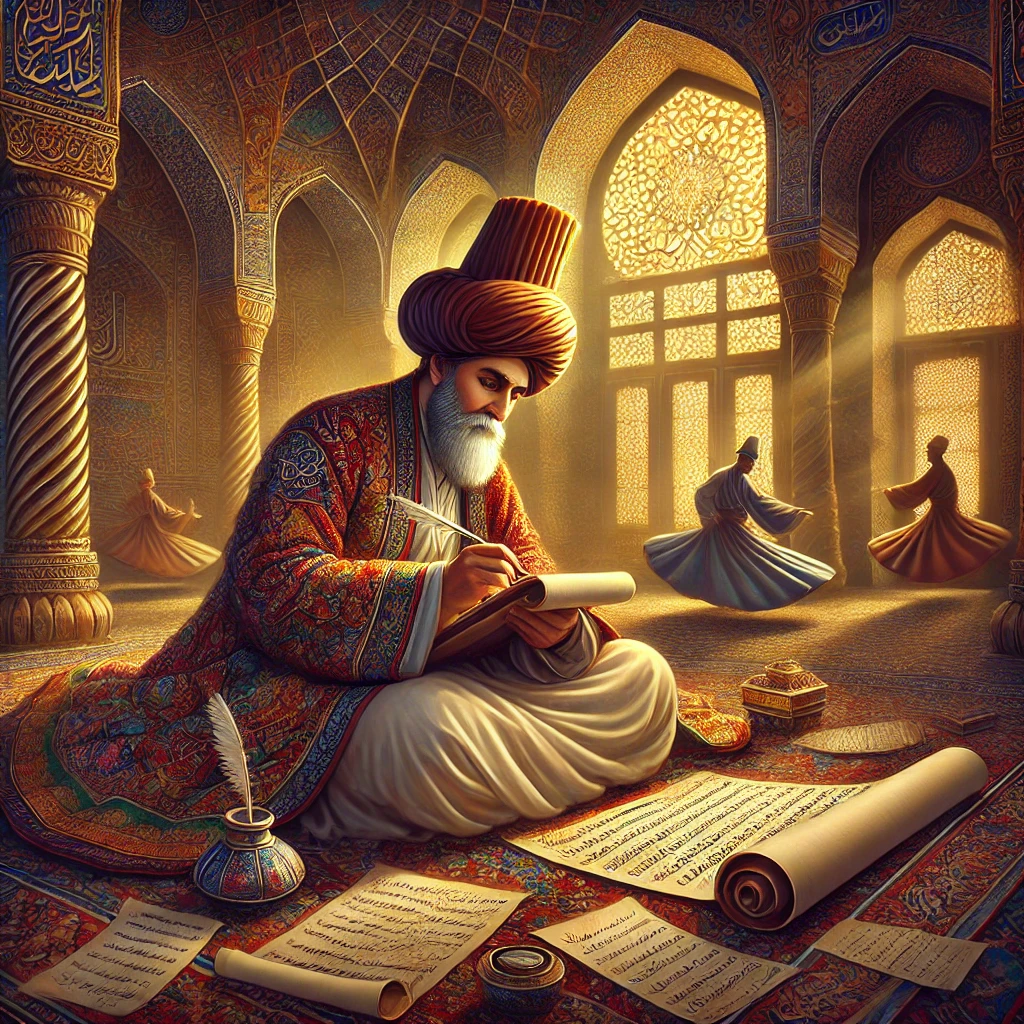
The Masnavi
The Masnavi, written by the 13th-century Persian poet and Sufi mystic Jalāl ad-Dīn Muhammad Rūmī, is a six-volume poem widely celebrated as one of the greatest works of mystical literature. Composed in rhyming couplets, it serves as a practical guide to the Sufi path, illuminating key aspects of spiritual life such as love, unity, and the journey of the soul toward God.
Rumi employs fables, parables, and anecdotes that reflect both everyday experiences and deeper metaphysical truths. These stories often revolve around moral dilemmas, illustrating how struggles with ego, attachment, and ignorance can veil one from true understanding. Through vivid imagery and eloquent language, the Masnavi encourages readers to cultivate a heart-centered devotion, emphasizing self-awareness, humility, and unwavering trust in the Divine.