
The prevailing opinion among theologians as well as in the mind of the ordinary man seems to be that Judaism and mysticism stand at the opposite poles of thought, and that, therefore, such a phrase as Jewish mysticism is a glaring and indefensible contradiction in terms.
Jewish Mysticism
Jewish Mysticism challenges the misconception that Judaism and mysticism are incompatible, asserting that mysticism has deep roots in Jewish history, dating back to the Old Testament.
It highlights the balance mysticism brings to Judaism, emphasizing inward spirituality and divine connection alongside legalistic practices. The text explores mystical experiences and teachings, such as the Ten Sefirot and the Merkabah, which symbolize paths to divine presence. It delves into esoteric wisdom, the role of angels and the Divine Word, and the soul’s journey towards union with the divine.
The Zohar, a key Kabbalistic text, is discussed for its rich theological framework. Overall, this text on Jewish Mysticism reveals how mysticism enriches Judaism by highlighting the pursuit of direct, personal experiences with the divine, balancing the external observances with an inner spiritual quest.
Unable to load audio
Jewish mysticism is as old as the Old Testament - nay, as old as some of the oldest parts of the Old Testament.
The Pauline anti-thesis of law and faith has falsely stamped Judaism as a religion of unrelieved legalism; and mysticism is the irreconcileable enemy of legalism.
The check came in the shape of mysticism. It corrected the balance. It showed that Judaism has a place not only for Reason but for Love too. It showed that the ideal life of the Jew was, not a life of outward harmony with rules and prescriptions, but a life of inward attachment to a Divine Life which is immanent everywhere, and that the crown and consummation of all effort consists in finding a direct way to the actual presence of God.
Nowhere in Jewish literature is the idea of prayer raised to such a pitch of sublimity as it is in the lives and writings of the Jewish mystics.
Mystical religion does, of course, transcend all the barriers which separate race from race and religion from religion. The mystic is a cosmopolitan, and, to him, the differences between the demands and beliefs and observances of one creed and those of another are entirely obliterated in his one all-absorbing and all-overshadowing passion for union with Reality.
He has the immediate vision; he hears the still small voice speaking clearly to him in the silence of his soul.
They seem to have lived on the borderland of an unusual ecstasy, experiencing extraordinary invasions of the Divine, hearing mystic sounds and seeing mystic visions which, to them, were the direct and immediate revelations of the deepest and most sacred truths.
The Ten Sefirot have close connections with these doctrines of letters - secret doctrines about the Divine nature, about creation, about the relations subsisting between God and the universe.
A certain esoteric wisdom and capacity for doing things, unknown to the multitudes, was vouchsafed to certain bodies of men, who by the superior purity of their living, by their unabated devotion to the things of the spirit, and by their cultivation of a kind of brotherhood in which simplicity, single-mindedness, and charity were the reigning virtues, were enabled to enjoy a living in the world of the unseen.
The whole of Jewish mysticism is really nothing but a commentary on the Jewish Bible, an attempt to pierce through to its most intimate and truest meaning; and what is the Bible to the Jew but the admonisher to be loyal to the traditions of his fathers?
The Old Testament shines forth with sublime examples of men whose communion with God was a thing of intensest reality to them, and whose conviction of the 'nearness' of the Divine was beyond the slightest doubt.
The idea of silence or secrecy was frequently employed by the early Rabbis in their mystical exegesis of Scripture.
The earliest beginnings of this mysticism are usually accredited, by modern Jewish scholars, to the Essenes.
To carry out a commandment from pure love, means, in Jewish theology of all ages, to attain a high stage of mystic elation which can only be arrived at as the result of a long preliminary series of arduous efforts in the upward path.
The first chapter of Ezekiel has played a most fruitful part in the mystical speculations of the Jews.
'Why, O master, hast thou dismounted from thy ass?' asked the disciple. 'Is it possible,' replied he, 'that I will ride upon my ass at the moment when thou art expounding the mysteries of the Merkabah, and the Shechinah is with us, and the ministering angels are accompanying us?'
He sought no explanation of them because he was assured that they stood for something which did not need explaining.
He felt instinctively that the Merkabah typified the human longing for the sight of the Divine Presence and companionship with it.
The remark that 'the Shechinah is with us and the ministering angels are accompanying us' emphasises two salient features of Rabbinic mysticism.
Ezekiel's image of Yahve riding upon the chariot of the 'living creatures,' accompanied by sights and voices, movements and upheavals in earth and heaven, lying outside the range of the deepest ecstatic experiences of all other Old Testament personages, was for the Jewish mystic a real opening, an unveiling, of the innermost and impenetrable secrets locked up in the interrelation of the human and the divine.
The door is flung wide open so that man, at the direct invitation of God, can come to the secret for which he longs and seeks.
The human movement from within is but a response to a larger Divine movement from without.
The Chariot (Merkabah) was thus a kind of 'mystic way' leading up to the final goal of the soul. Or, more precisely, it was the mystic 'instrument,' the vehicle by which one was carried direct into the 'halls' of the unseen.
It was the aim of the mystic to be a 'Merkabah-rider,' so that he might be enabled, while still in the trammels of the flesh, to mount up to his spiritual Eldorado.
One can see quite clearly how its governing idea is based on a conception general to all the mystics, that the quest for the ultimate Reality is a kind of pilgrimage, and the seeker is a traveller towards his home in God.
It appears to have been a confused angelology, one famous angel Metatron playing a conspicuous part.
In the Mishna, Ḥaggigah, ii. 1, it is said: "It is forbidden to explain the first chapters of Genesis to two persons, but it is only to be explained to one by himself.
In the same passage another Rabbi (Ze‘era) of the 3rd century A.D. remarks, with a greater stringency: "We may not divulge even the first words of the chapters [neither of Genesis nor Ezekiel] unless it be to a 'chief of the Beth Din' 1 or to one whose heart is tempered by age or responsibility".
The organic life, the self, conscious and unconscious, must be moulded and developed in certain ways; there must be an education, moral, physical, emotional; a psychological adjustment, by stages, of the mental states which go to the make-up of the full mystic consciousness.
As Evelyn Underhill says: "Mysticism shows itself not merely as an attitude of mind and heart, but as a form of organic life.
The Ḥashmal, by the way, was interpreted by the Rabbis as: (a) a shortened form of the full phrase ḥāyot ěsh mē-māl-lē-loth, i.e. 'the living creatures of fire, speaking'; or (b) a shortened form of ‘ittim ḥāshoth ve-‘ittim mě-mălle-lōth, i.e. 'they who at times were silent and at times speaking'.
In the literature of the mediæval Kabbalah, the Ḥashmal belongs to the 'Yetsiratic' world (i.e. the abode of the angels, presided over by Metatron who was changed into fire; and the spirits of men are there too).
The mediæval Christian mystics - Ruysbroeck, Catherine of Genoa, Jacob Boehme, and others - appeal constantly to the same figure for the expression of their deepest thoughts on the relations between man and the Godhead.
The choice of the metaphor probably rests on the fact that 'fire' can be adapted to symbolise either or both of the following truths: (a) the brightness, illumination which comes when the goal has been reached, when the quest for the ultimate reality has at last been satisfied; (b) the all-penetrating, all-encompassing, self-diffusing force of fire is such a telling picture of the mystic union of the soul and God.
These latter words are the description of the ecstatic state, the moments of exaltation, the indescribable peace and splendour which the soul of the mystic experiences when, disentangling itself from the darkness of illusion, it reaches the Light of Reality, the condition so aptly phrased by the Psalmist who said: "For with thee is the fountain of life; in thy light shall we see light" (Psalm, xxxvi. 9)
The bird flying in the environment of this unrestrained light, must inevitably be consumed by the fire of it.
The angel is a kind of representative of the Deity among mortals. It is a sort of God in action. God is very near man and not transcendent.
The angel and the Logos (Word) or Logoi (Words) have very much the same nature and fulfil very much the same function.
The term 'angel' stands for the powers embodied in all earthly phenomena, the world-forces which are outflowings of God and represent the aspect of the Divine activity in the universe.
How to bridge the chasm between God and the world, how at the first creation of man it was possible for God who is the all-holy and all-perfect, to come into contact with imperfect man, is an oft-recurring subject of speculation in the Talmud and Midrashim.
The world impregnated with traces and symptoms of a Divine Life.
This air is the abode of incorporeal souls, since it seemed good to the Creator of the universe to fill all parts of the world with living creatures.
The truth is that God was in many senses brought very near, and the angel was but an aspect of this 'nearness.' God was immanent as well as transcendent, and the angel was a sort of emanation of the Divine, an off-shoot of Deity, holding intimate converse with the affairs of the world.
Philo's Logos and Logoi and his angelology are nothing but symbols of abstract thinking on the ways in which the Deity participates in the affairs of men and of the world.
The Rabbis often materialised the Shechinah and gave strongly definite personality to their 'angels'.
The Logos as the being who guided the patriarchs, as the angel who appeared to Hagar, as the cloud at the Red Sea, as the Divine form who changed the name of Jacob to Israel.
An angel as an 'incorporeal soul' is more akin to the Aristotelian doctrine of 'intelligences,' the intermediate beings between the Prime Cause and existing things.
It would be incorrect to say that he derived this theology from the Rabbinic sources. Platonic and Stoic teachings are largely responsible for them. But Philo endeavoured to bring them into line with Rabbinic modes of Biblical interpretation.
While being external to man, it is, in a sense, internal too, Sa‘adiah being of opinion that they were visions seen during prophetic ecstasy rather than outward realities.
Angels are emanations of the Divine working here below. Man is in a double sense made by them. It was they who had a hand in his creation. It is they who fill his environment, and make him realise that he is ever in the grip of a Presence from which there is no escaping.
As for the angels, some are created for the time being, out of the subtle elements of matter [as air or fire]. Some are eternal angels [i.e. existing from everlasting to everlasting], and perhaps they are the spiritual intelligences of which the philosophers speak.
Philo's doctrine is similar. Thus he says: "For God, not condescending to come down to the external senses, sends His own words (logoi) or angels for the sake of giving assistance to those who love virtue. But they attend like physicians to the diseases of the soul, and apply themselves to heal them, offering sacred recommendations like sacred laws, and inviting men to practise the duties inculcated by them, and, like the trainers of wrestlers, implanting in their pupils strength and power and irresistible vigour.
The angels are not corporeal; this is what Aristotle also said; only there is a difference of name; he calls them 'separate intelligences' (sichlim nifrādīm), whereas we designate them angels.
But these men pray to be nourished by the word (logos) of God. But Jacob, raising his head above the word, says that he is nourished by God Himself, and his words are as follows: The God in whom my father Abraham and Isaac were well pleased; the God who has nourished me from my youth upwards to this day; the angel who has delivered me from all my evils, bless these children.
This branch of Philonic theology is mirrored in the early Jewish, as well as in the early Christian, teaching about God.
The angel in whom God's name exists is, said the Rabbis, Metatron.
He represents the active phase of Deity as manifested in the universe.
Metatron is the helper to the Deity. Metatron is the guide and instructor.
Wisdom is the quality through which God acts in the world, and by the instrumentality of which the Deity is known to man.
Wisdom is but "a quality belonging to God, one of His attributes by which He makes Himself known and felt in the world of men and in the human heart, one of the elements in the Divine nature which is most in sympathy with the innate tendency in man to go on striving ever upward and onward".
The Word in this extraordinary pronouncement holds the idea of the Divine Energy which is operative in all things and which "links the Transcendent Godhead with His creative spirit, creature with Creator, and man with man".
The world of matter and of spirit is the scene of the immanent manifestation of Divine Wisdom, Divine Power, Divine Love, Divine Justice.
The Old Testament, which alone is, and ever was, the Bible of the Jew, contains two oft-recurring ideas which rank among the principal elements of its theological teaching. These ideas are: (a) God as Father; (b) God as King.
'Shechinah' comes from shachan = to dwell. The whole edifice of thought about the Shechinah is based upon such passages in the Old Testament as "And let them make me a sanctuary that I may dwell among them" (Exodus, xxv. 8). "Defile ye not therefore the land which ye shall inhabit, wherein I dwell: for I the Lord dwell among the children of Israel" (Numbers, xxxv. 34). "And I will set my tabernacle among you and my soul shall not abhor you. And I will walk among you and will be your God, and ye shall be my people" (Leviticus, xxvi. 11, 12)
The blending of the two even went so far as to prompt the Rabbis to say - what is sometimes falsely and foolishly described as 'grotesque' - that God prays and the synagogue is His house of prayer.
The fatherhood of God necessarily involves the sonship of man.
The Rabbi, however, who stayed on and succeeded in eliciting from the Shechinah a promise that the ministering angels should henceforth cease from troubling him, is the type of the mystic who feels the mental and physical elation, the joy, the rapture, the triumph consequent upon the conviction of his having, at last, reached the goal of his quest - the sight, sound and touch of the Ultimate Reality.
Writers on mysticism, no matter to what school of religious thought they may happen to belong, familiarise us with the great fact that the mystic, by reason of the high levels of spiritual intensity on which his life is lived, experiences certain physical sensations which enable him to see or to hear something of the mystery of the Divine Presence.
A feature of the Shechinah mysticism which deserves a deeper appreciation than is usually accorded it, is to be found in the reiterated Rabbinic belief that goodness and piety radiate an atmosphere of divinity which infects all who breathe it, with a new impulse towards the good, the beautiful and the true.
Christian mysticism invariably quotes the experiences of Paul in this connection - Paul who was so deeply struck by the brilliant light about him that he "was three days without sight and neither did eat nor drink" (Acts, ix. 9).
The Jew is possessed by the power of a Spirit of Love which encircles him, holds him in its grip, assures him that forgiveness, protection from enemies, safety from mischief, every coveted thing in heaven and earth, are his
Evelyn Underhill says of a certain mediæval German mystic, Rulman Merswin, that "a brilliant light shone around him; he heard in his ears a Divine voice of adorable sweetness; he felt as if he were lifted from the ground, and carried several times round the garden" (The Mystic Way, p. 162).
Companionship with the good must be acquired at all costs. It is the dynamic power for opening the door to the spiritual world.
His whole life is, as it were, a response to it, infected with it, absorbed in it.
From the first of the quotations just given, it follows that 'Jew' is a term of the widest scope. From the second one infers that the Jew fills no higher a place in the Divine favour than do the good and worthy of all men and races.
One of the distinguishing features of the mystical temperament is the contrast in the effects which this sudden invasion of a Divine Presence had upon the objects of the visitation. The two Rabbis who left the synagogue did so, most probably, as the result of the fearful weakening and depressing effect of the vision. The Rabbi, however, who stayed on and succeeded in eliciting from the Shechinah a promise that the ministering angels should henceforth cease from troubling him, is the type of the mystic who feels the mental and physical elation, the joy, the rapture, the triumph consequent upon the conviction of his having, at last, reached the goal of his quest - the sight, sound and touch of the Ultimate Reality.
Companionship with the good must be acquired at all costs. It is the dynamic power for opening the door to the spiritual world. The man of virtue is Shechinah-possessed; and to touch only the hem of his garment is to become Shechinah-possessed too.
The Shechinah is for Israel only. The Shechinah is primarily for Israel. God is near to the Jew, far from the non-Jew. These are seemingly natural and correct deductions from the Rabbinic records. If so, is not the term 'mysticism' as applied to the Shechinah a misnomer, seeing that the primal assumption of mysticism is the truth that every soul, notwithstanding race or religion, can have intimate intercourse with the Divine? The answer is this: The title 'Jew' or 'Israelite' is frequently used by the Rabbis in a more comprehensive sense than they are usually given credit for.
Thus T.B. Ḳiddushin says: "Whosoever denies the truth of idolatry becomes a believer in the whole Torah." T.B. Megillah, says: "Whosoever denies idolatry is called a Jew." In the Midrash Sifra on Leviticus there is a comment on Psalm, "Do good, O Lord, unto those that be good, and to them that are upright in their heart." "The Psalmist," says the Sifra, "does not say 'Do good to the Priests or to the Levites or to the Israelites.' But he says 'Do good unto those that be good.'" From the first of the quotations just given, it follows that 'Jew' is a term of the widest scope. From the second one infers that the Jew fills no higher a place in the Divine favour than do the good and worthy of all men and races.
Rabbi Samuel b. Meir, the great Rabbinic commentator of the 12th century says, "God loveth also the nations of the world." Of King Solomon's chariot it is said (Canticles, iii. 10) that "the midst thereof is paved with love." "This love in the midst thereof," say the Rabbis, "is the Shechinah." It is certainly not meant in any sectarian sense. The Divine Chariot in Jewish mysticism is, broadly, the idealised universe. And all degrees of creation from amoeba to man hold and reveal the traces of the Divine love which is ever born anew in our hearts and which guarantees the ultimate goodness of the world.
The date and origin of this extraordinary book - the oldest philosophical work in the Hebrew language - are shrouded in obscurity.
Emanation implies that all existing things are successive outflowings or outgoings of God. God contains within Himself all. He is perfect, incomprehensible, indivisible, dependent on nothing, in need of nothing. Everything in the cosmos, all finite creatures animate and inanimate, flow out, radiate, in a successive series, from God, the Perfect One.
Everything is originally comprehended in Him, "with no contrasts of here or there, no oppositions of this and that, no separation into change and variation".
The multiplicity that one beholds in the cosmos, the whole panorama of thought, action, goodness, badness, the soul, the mind - all things that go to make up the pageant of man's life in the universe, are emanations, radiations from the one Unity, manifestations of the God from whom all things flow and to whom they must all finally return because they are ultimately one with the One, just as the flame is one with the candle from which it issues.
It is a mystical philosophy drawn from the sounds, shapes, relative positions, and numerical values of the letters of the Hebrew alphabet.
In all probability it originated with the Rabbis of the Talmud in the first three centuries of the Christian era. Thus, a passage in T.B. Ḥaggigah, speaks of the "Ten agencies through which God created the world, wisdom, insight, cognition, strength, power, inexorableness, justice, right, love, mercy."
There are Ten Sefirot - ten, not nine; ten, not eleven. Act in order to understand them in thy wisdom and thy intelligence; so that thy investigations exercise themselves continually upon them; also thy speculations, thy knowledge, thy thought, thy imagination; make things to rest upon their principle and re-establish the Creator upon his foundation.
By means of the twenty-two letters, by giving them a form and a shape, by mixing them and combining them in different ways, God made the soul of all that which has been created and of all that which will be.
The Ten Sefirot are like the fingers of the hand, ten in number, five corresponding to five. But in the middle of them is the knot of the Unity.
The first of the Sefirot, one, is the spirit (Ruaḥ) of the living God (blessed be His Name, blessed be the Name of Him who inhabits eternity!). The spirit, the voice, and the word, these are the Holy Spirit.
The three which have just been considered, the three 'mothers' or 'parent' letters (Aleph, Mem, Shin) which symbolise the elements, air, fire, and water, which together make up the cosmos.
The remaining six Sefirot are the six dimensions of space - the four cardinal points of the compass, in addition to height and depth.
The seven double letters typify the 'contraries' in the cosmos, the forces which serve two mutually opposed ends.
The twelve 'simple' letters are emblematic of the twelve signs of the zodiac, the twelve months of the year, the twelve organs in the human body which perform their work independently of the outside world and are subject to the twelve signs of the zodiac.
This brings us to two doctrines of Jewish mysticism which appear for the first time in the Book Yetsirah, and which were developed subsequently on diverse lines. These are: the doctrine of emanation; the Ten Sefirot.
It shows how both Jewish and Christian mysticism are alike indebted to one and the same set of sources. Gnosticism and its development - the Alexandrian Neoplatonism.
When the spirits and the souls come out of Eden they all possess a certain appearance which, later on, is reflected in the face.
Woe unto the man," says Simeon ben Yoḥai," who sees in the Torah nought but simple narratives and ordinary words. The narratives (or words) of the Law are the garment of the Law. Woe unto him who takes this garment for the Law itself!
Evil, sin, and their personifications, the demons, are termed kélīfoth, i.e. the coverings, wrappings, externals of all existing things. Just as the covering (or husk) of anything is not the real thing and far inferior to it, so sin and evil are, as it were, the gross, inferior, imperfect aspects of creation.
God as the En-Sof and as a Being utterly divested of attributes is an idea that can only be postulated negatively.
It is man's duty to strive after union with the Infinite, his pursuit of the finite leads him to that which lies at the extremity of the Divine nature rather than that which lies at the heart of it. This constitutes evil. It is a state of absence, a negation, because man who, like the universe, is but one of the manifestations of the Divine, can only attain the real when he seeks the Real who is his fount, his home.
The idea of God using the Heavenly Man (Adam ‘Ilā-ā) as a chariot on which to descend indicates a noteworthy identity of teaching in the Zohar and Plotinus.
He is the beginning as well as the end of all stages (dargin); upon Him are stamped (etrashim) all the stages. But He can only be called One, in order to show that although He possesses many forms, He is nothing other than ONE.
The idea of the Heavenly Man, or Adam Kadmon ('First' or 'Original' Man), or Shechinta Tā-tā-ā ('Lower' or 'Terrestrial' Shechinah), is vital to an understanding of the Zohar and of all Kabbalistic literature.
He made this world of below to correspond with the world of above. Everything which is above has its pattern here below and all constitutes a unity.
The real part of man is his soul, and the things just mentioned, the skin, flesh, bones, and veins, are only an outward covering, a veil, but are not the man.
For, inside man, there is the secret of the Heavenly Man. . . . Everything below takes place in the same manner as everything above.
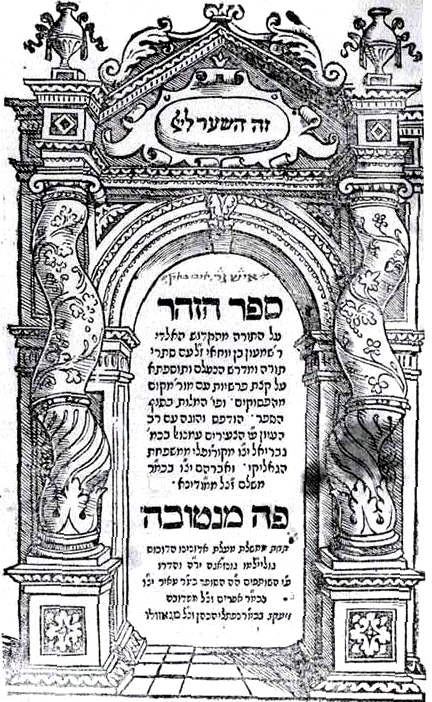
The Zohar is, par excellence, the textbook of Jewish mediæval mysticism. Its language is partly Aramaic and partly Hebrew. While purporting to be but a commentary on the Pentateuch, it is, in reality, quite an independent compendium of Kabbalistic theosophy.
Man, having the privilege to behold everywhere the Divine image - the world being an embodiment of God - can, if he will, make his way to the Invisible Author of all; can have union with the Unseen.
A ubiquitous term is En-Sof, applied to the Deity. These words mean literally 'No End.' The Deity is boundless, endless.
In the firmament above which covers all things, signs are engraven in which are fixed hidden things and secrets.
Before having created any shape in the world, before having produced any form, He was alone, without form, resembling nothing. It is forbidden to picture Him by any form or under any shape whatsoever, not even by His holy name, nor by a letter [of the alphabet] nor by a point. But after He had created the form of the Heavenly Man (Adam ‘Ilā-ā) He used him as a chariot (Merkābāh) on which to descend.
ALL finite creatures are, in divergent senses and varying degrees, part and parcel of the Deity.
Creatio ex nihilo is unthinkable, seeing that God, in the Neoplatonic view, is the Perfect One, 'an undivided One,' to whom no qualities or characteristics can be ascribed, and to whom, therefore, no such idea as that of intention or purpose, or change or movement, can be applied.
All existences are emanations from the Deity. The Deity reveals Himself in all existences because He is immanent in them. But though dwelling in them, He is greater than they. He is apart from them. He transcends them.
In the world to come there is neither eating nor drinking, nor marrying, nor bargaining, nor envy, nor hatred, nor quarrel; but the righteous sit, with crowns upon their heads, and feed upon the splendour of the Shechinah.
The Crown represents, as it were, the first stage by which the Infinite Being takes on the properties of the finite and becomes drawn out of His impenetrable isolation.
The Most Ancient One is at the same time the most Hidden of the hidden. He is separated from all things, and is at the same time not separated from all things. For all things are united in Him, and He unites Himself with all things. There is nothing which is not in Him.
The first of the Sefirot denotes, then, the primordial Divine Thought (or Divine Will, as the Hebrew commentators often style it).
Wisdom and Intelligence are the second and third of the Ten Sefirot. Wisdom is the 'father,' i.e. the masculine active principle which engenders all things and imposes on them form and measure. Intelligence is the 'mother,' the passive, receptive principle.
He has a shape, and one can say that He has not one. In assuming a shape, He has given existence to all things.
He made ten lights spring forth from His midst, lights which shine with the form which they have borrowed from Him, and which shed everywhere the light of a brilliant day.
The Ancient One, the most Hidden of the hidden, is a high beacon, and we know Him only by His lights, which illuminate our eyes so abundantly. His Holy Name is no other thing than these lights.
These three, father, mother, son (i.e. the two Sefirot, viz. Wisdom and Intelligence, and their offspring Reason), hold and unite in themselves all that which has been, which is, and which will be.
The name 'I am' signifies the unity of all things.
Afterwards He brought out that light which is the celestial mother, and when she bare a child, then He called Himself 'that I am'.
The Creator is Himself, at one and the same time, knowledge, the knower, and the known.
The first three Sefirot form a triad constituting the world as a manifestation of the Divine Thought.
The Divine Thought is the source whence emanate two opposing principles, one active or masculine, the other passive or feminine. The former is Mercy (Ḥesed), the latter is Justice (Dīn). From the union of these two there results Beauty (Tifěrěth).
The Ten Sefirot together are thus a picture of how an infinite, undivided, unknowable God takes on the attributes of the finite, the divided, the knowable, and thus becomes the cause of, the power lying at the bottom of, all the multifarious modes of existence in the finite plane - all of which are thus a reflection of the Divine.
The third triad are: Victory (Nezaḥ), Glory (Hōd), and Foundation (Yesōd). The first of these is the masculine active principle. The second is the feminine passive principle, while the third is the effect of their combination.
The last of the Sefirot is Royalty (Malkūt). This tenth Sefirah indicates the abiding truth of the harmonious co-operation of all the Sefirot, thus making the universe in its orderliness and in its symmetry a true and exact manifestation of the Divine Mind - an ‘Olam Azilut, a world of emanation.
The universal infiltration of the light of the En-Sof, its diffusion throughout all the Sefirot, gave rise to the idea of the existence of a changeable and an unchangeable element in each of the Sefirot.
That the Zohar is a debtor to a double source - the Talmudic teachings and the teachings of the Neoplatonists - is very apparent from its treatment of the soul.
Neoplatonism gave to the Zohar the idea of the soul as an emanation from the 'Overmind' of the universe. There was originally one 'Universal Soul,' or 'Over-soul,' which, as it were, broke itself up and encased itself in individual bodies. All individual souls are, hence, fragments of the 'Oversoul,' so that although they are distinct from one another they are, in reality, all one.
There are many instances in Talmudic literature, of men seeing the Shechinah at the hour of death. It is the signal of the return of Neshāmāh to its home, the Oversoul, of which it is but a loosened fragment; and the return can only begin after it has completed its education within the life-limits of an earthly body.
All souls must undergo transmigration; and men do not understand the ways of the Holy One (blessed be He). They know not that they are brought before the tribunal both before they enter into this world and after they leave it. They know not the many transmigrations and hidden trials which they have to undergo, nor do they know the number of souls and spirits (Ruaḥ and Nefesh) which enter into the world, and which do not return to the Palace of the Heavenly King. Men do not know how the souls revolve like a stone which is thrown from a sling. But the time is drawing nigh when these hidden things will be revealed.
The soul's most visible, most tangible, most perceivable quality is love. The soul is the root of love. Love is the symbol of the soul.
Whosoever serves God out of love, comes into union (itdaḅak) with the place of the Highest of the High, and comes into union, too, with the holiness of the world which is to be.
But if Neshāmāh is so exalted, so sacrosanct, why should it have emanated from its immaculate source at all, to become tainted with earth? The Zohar anticipates our question and gives its answer as follows: "If thou inquirest why it [i.e.. the soul] cometh down into the world from so exalted a place and putteth itself at such a distance from its source, I reply thus: It may be likened to an earthly monarch to whom a son is born. The monarch takes the son to the countryside, there to be nourished and trained until such a time as he is old enough to accustom himself to the palace of his father. When the father is told that the education of his son is completed, what does he do out of his love for him? In order to celebrate his home-coming, he sends for the queen, the mother of the lad. He brings her into the palace and rejoices with her the whole day long.
When the soul has completed the cycle of its earthly career and hurries back to become blended with the Oversoul, it revels in ecstasies of love, which the Zohar describes with a wealth of poetic phraseology.
When Adam our first father dwelt in the garden of Eden he was clothed, as men are in heaven, with the Divine light. When he was driven forth from Eden to do the ordinary work of earth, then Holy Writ tells us that "the Lord God made for Adam and for his wife coats of skin and clothed them." For, ere this, they wore coats of light, of that light which belongs to Eden.
Man's good deeds upon earth bring down on him a portion of the higher light which lights up heaven. It is that light which covers him like a coat when he enters into the future world and appears before his Maker, the Holy One (blessed be He). It is by means of such a covering that he can taste of the enjoyments of the elect and look upon the face of the 'shining mirror.