
Dimensions are limitless; time is endless. Conditions are not invariable; terms are not final. Thus, the wise man looks into space, and does not regard the small as too little, nor the great as too much; for he knows that there is no limit to dimension. He looks back into the past, and does not grieve over what is far off, nor rejoice over what is near; for he knows that time is without end. He investigates fulness and decay, and does not rejoice if he succeeds, nor lament if he fails; for he knows that conditions are not invariable. He who clearly apprehends the scheme of existence does not rejoice over life, nor repine at death; for he knows that terms are not final.
Musings of a Chinese Mystic
Zhuang ZhouMusings of a Chinese Mystic is a collection of philosophical reflections attributed to Zhuang Zhou (Zhuangzi), an influential Taoist philosopher. The text delves into the nature of reality, the limitations of human knowledge, and the fluidity of identity.
The work emphasizes the ineffable and transcendental nature of Tao (the Way), which lies beyond material existence and human comprehension. Themes include the impermanence of life and death, the importance of aligning with the natural order, and the futility of imposing rigid structures on the ever-changing world.
The text also explores the concept of ultimate harmony, where true wisdom involves embracing the unknown and finding peace in the natural flow of life. By promoting a detached, intuitive approach to existence, Chuang Tzŭ’s musings encourage a profound understanding of the self and the universe.
Unable to load audio
Now that you have emerged from your narrow sphere and have seen the great ocean, you know your own insignificance, and I can speak to you of great principles.
The universe and I came into being together; and I, and everything therein, are One.
By and by comes the Great Awakening, and then we find out that this life is really a great dream. Fools think they are awake now, and flatter themselves they know if they are really princes or peasants. Confucius and you are both dreams; and I who say you are dreams,—I am but a dream myself. This is a paradox. To-morrow a sage may arise to explain it; but that tomorrow will not be until ten thousand generations have gone by.
Granting that you and I argue. If you beat me, and not I you, are you necessarily right and I wrong? Or if I beat you and not you me, am I necessarily right and you wrong? Or are we both partly right and partly wrong? Or are we both wholly right or wholly wrong? You and I cannot know this, and consequently the world will be in ignorance of the truth.
How do I know that love of life is not a delusion after all? How do I know but that he who dreads to die is as a child who has lost the way and cannot find his home?
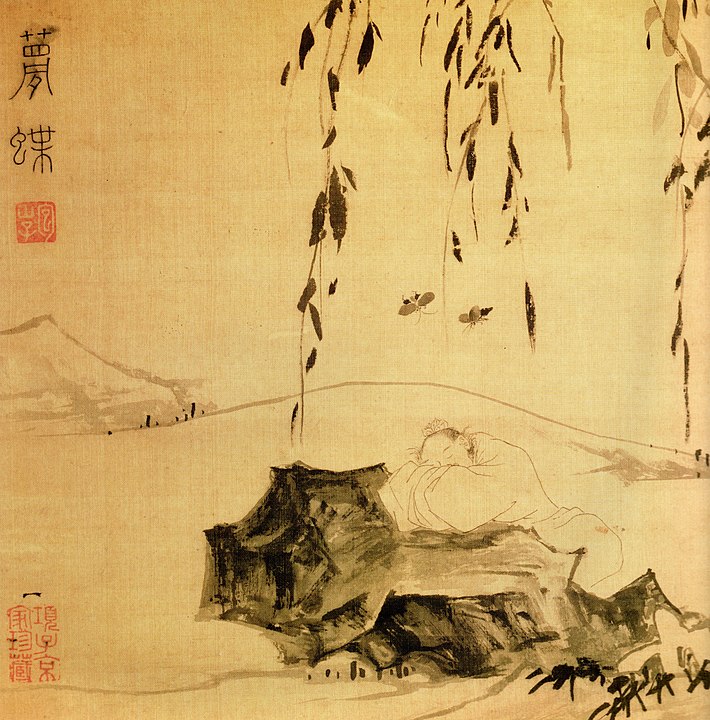
Once upon a time, I, Chuang dreamt I was a butterfly, fluttering hither and thither, to all intents and purposes a butterfly. I was conscious only of following my fancies as a butterfly, and was unconscious of my individuality as a man. Suddenly I awaked, and there I lay, myself again. Now I do not know whether I was then a man dreaming I was a butterfly, or whether I am now a butterfly dreaming I am a man. Between a man and a butterfly there is necessarily a barrier. The transition is called metempsychosis.
I showed myself to him just now as Tao appeared before time was. I was to him as a great blank, existing of itself. He knew not who I was. His face fell. He became confused. And so he fled.
A man's knowledge is limited; but it is upon what he does not know that he depends to extend his knowledge to the apprehension of God.
And the true Sage, taking his stand upon the beauty of the universe, pierces the principles of created things.
Apparently destroyed, yet really existing; the material gone, the immaterial left,—such is the law of creation, which passeth all understanding. This is called the root, whence a glimpse may be obtained of God.
Chuang Tzŭ said: "O my exemplar! Thou who destroyest all things, and dost not account it cruelty; thou who benefitest all time, and dost not account it charity; thou who art older than antiquity and dost not account it age; thou who supportest the universe, shaping the many forms therein, and dost not account it skill; this is the happiness of God!"
For man's intellect, however keen, face to face with the countless evolutions of things, their death and birth, their squareness and roundness,— can never reach the root. There creation is, and there it has ever been.
Tao is something beyond material existences. It cannot be conveyed either by words or by silence. In that state which is neither speech nor silence, its transcendental nature may be apprehended.
The great One is omnipresent. The great Negative is omnipotent. The great Nomenclature is all-inclusive. The great Uniformity is all-assimilative.
The ultimate end is God. He is manifested in the laws of nature. He is the hidden spring. At the beginning, he was. This, however, is inexplicable. It is unknowable. But from the unknowable we reach the known.
The potter says: "I can do what I will with clay. If I want it round, I use compasses; if rectangular, a square." The carpenter says: "I can do what I will with wood. If I want it curved, I use an arc; if straight, a line." But on what grounds can we think that the natures of clay and wood desire this application of compasses and square, of arc and line?
Cultivate unity. You hear not with the ears, but with the mind; not with the mind, but with your soul. But let hearing stop with the ears. Let the working of the mind stop with itself. Then the soul will be a negative existence, passively responsive to externals. In such a negative existence, only Tao can abide. And that negative state is the fasting of the heart.
Does not universal love contradict itself? Is not your elimination of self a positive manifestation of self?
He never preaches at people, but puts himself into sympathy with them.
If he could only roam empty through life, who would be able to injure him?
If you can enter this man's domain without offending his amour propre, cheerful if he hears you, passive if he does not; without science, without drugs, simply living there in a state of complete indifference, you will be near success.
If you make a show of being perfect and obtrude yourself, the Prince's mood will be doubtful.
The water remains quietly within, and does not overflow. It is from the cultivation of such harmony that virtue results.
For travelling by water there is nothing like a boat. For travelling by land there is nothing like a cart. This because a boat moves readily in water; but were you to try to push it on land you would never succeed in making it go.
Here is a man whose disposition is naturally of a low order. To let him take his own unprincipled way is to endanger the State. To try to restrain him is to endanger one's personal safety. He has just wit enough to see faults in others, but not to see his own. I am consequently at a loss what to do.
A son must go whithersoever his parents bid him. Nature is no other than a man's parents. If she bid me die quickly, and I demur, then I am an unfilial son. She can do me no wrong. Tao gives me this form, this toil in manhood, this repose in old age, this rest in death. And surely that which is such a kind arbiter of my life is the best arbiter of my death.
In death there is no sovereign above, and no subject below. The workings of the four seasons are unknown. Our existences are bounded only by eternity. The happiness of a king among men cannot exceed that which we enjoy.
The Master came, because it was his time to be born; he went, because it was his time to die. For those who accept the phenomenon of birth and death in this sense, lamentation and sorrow have no place.
To have attained to the human form must be always a source of joy. And then, to undergo countless transitions, with only the infinite to look forward to,—what incomparable bliss is that! Therefore it is that the truly wise rejoice in that which can never be lost, but endures alway.
He who knows what God is, and who knows what Man is, has attained. Knowing what God is, he knows that he himself proceeded therefrom. Knowing what Man is, he rests in the knowledge of the known, waiting for the knowledge of the unknown.
How does the Sage seat himself by the sun and moon, and hold the universe in his grasp? He blends everything into one harmonious whole, rejecting the confusion of this and that.
The perfect man ignores self; the divine man ignores action; the true Sage ignores reputation.
The pure men of old acted without calculation, not seeking to secure results. They laid no plans. Therefore, failing, they had no cause for regret; succeeding, no cause for congratulation.
The pure men of old did not know what it was to love life nor to hate death. They did not rejoice in birth, nor strive to put off dissolution.
The repose of the Sage is not what the world calls repose. His repose is the result of his mental attitude. All creation could not disturb his equilibrium: hence his repose.
"Divine men," replied Confucius, "are divine to man, but ordinary to God. Hence the saying that the meanest being in heaven would be the best on earth; and the best on earth, the meanest in heaven."
A dog is not considered a good dog because he is a good barker. A man is not considered a good man because he is a good talker.
A man does not seek to see himself in running water, but in still water. For only what is itself still can instil stillness into others.
A man who knows that he is a fool is not a great fool.
And every one who attaches importance to the external, becomes internally without resource.
As to what the world does and the way in which people are happy now, I know not whether such happiness be real happiness or not.
Birth is not a beginning; death is not an end.
Discard the stimuli of purpose. Free the mind from disturbances. Get rid of entanglements to virtue. Pierce the obstructions to Tao.
For the perfect man employs his mind as a mirror. It grasps nothing: it refuses nothing. It receives, but does not keep. And thus he can triumph over matter, without injury to himself.
Get rid of small wisdom, and great wisdom will shine upon you. Put away goodness and you will be naturally good.
It is the delegated image of God. Your life is not your own. It is the delegated harmony of God. Your individuality is not your own. It is the delegated adaptability of God. Your posterity is not your own. It is the delegated exuviæ of God.
Joy and sorrow come and go, and over them I have no control.
Let knowledge stop at the unknowable. That is perfection.
TAKE no heed of time, nor of right and wrong; but, passing into the realm of the Infinite, take your final rest therein.
The best language is that which is not spoken, the best form of action is that which is without deeds.
The goodness of a wise ruler covers the whole empire, yet he himself seems to know it not. It influences all creation, yet none is conscious thereof.
The men of this world all rejoice in others being like themselves, and object to others not being like themselves.
The raison d’être of a fish-trap is the fish. When the fish is caught, the trap may be ignored. The raison d’être of a rabbit-snare is the rabbit. When the rabbit is caught, the snare may be ignored. The raison d’être of language is an idea to be expressed. When the idea is expressed, the language may be ignored.
To serve one's prince without reference to the act, but only to the service, is the perfection of a subject's loyalty.
To live with your wife, exclaimed Hui Tzŭ, and see your eldest son grow up to be a man, and then not to shed a tear over her corpse,—this would be bad enough. But to drum on a bowl, and sing; surely this is going too far. Not at all, replied Chuang Tzŭ. When she died, I could not help being affected by her death. Soon, however, I remembered that she had already existed in a previous state before birth, without form, or even substance; that while in that unconditioned condition, substance was added to spirit; that this substance then assumed form; and that the next stage was birth. And now, by virtue of a further change, she is dead, passing from one phase to another like the sequence of spring, summer, autumn and winter. And while she is thus lying asleep in Eternity, for me to go about weeping and wailing would be to proclaim myself ignorant of these natural laws.
When Chuang Tzŭ was about to die, his disciples expressed a wish to give him a splendid funeral. But Chuang Tzŭ said: "With Heaven and Earth for my coffin and shell; with the sun, moon, and stars, as my burial regalia; and with all creation to escort me to the grave,—are not my funeral paraphernalia ready to hand?" "We fear," argued the disciples, "lest the carrion kite should eat the body of our Master;" to which Chuang Tzŭ replied: "Above ground I shall be food for kites; below I shall be food for mole-crickets and ants. Why rob one to feed the other?"
You not being a fish yourself," said Hui Tzŭ, "how can you possibly know in what consists the pleasure of fishes?" "And you not being I," retorted Chuang Tzŭ, "how can you know that I do not know?" "If I, not being you, cannot know what you know," urged Hui Tzŭ, "it follows that you, not being a fish, cannot know in what consists the pleasure of fishes.
You May Also Enjoy
Tao Te Ching
The Tao Te Ching, attributed to Laozi, is a foundational text in Taoist philosophy. It explores the nature of the Tao (the Way), which is described as an indefinable force that underlies and sustains everything in the universe. The Tao is elusive, beyond words, and cannot be fully comprehended by human perception.
Instead, the text emphasizes living in harmony with the Tao through simplicity, humility, and non-action (wu wei), which means going with the flow of life and nature rather than forcing outcomes. Key concepts include opposites being interconnected (e.g., existence and non-existence), the benefits of softness and weakness over hardness and strength, and the ideal of ruling by example rather than control.
The Tao Te Ching teaches that true power and wisdom come from aligning with the natural order and embracing humility and selflessness. Through this, one can achieve balance, contentment, and a deeper understanding of life.