
Put away your books, be distracted no longer, they are not your portion. Rather, as if on the point of death, reflect like this: you are an old man, suffer this governing part of you no longer to be in bondage, no longer to be a puppet pulled by selfish impulse, no longer to be indignant with what is allotted in the present or to suspect what is allotted in the future.
Meditations of Marcus Aurelius
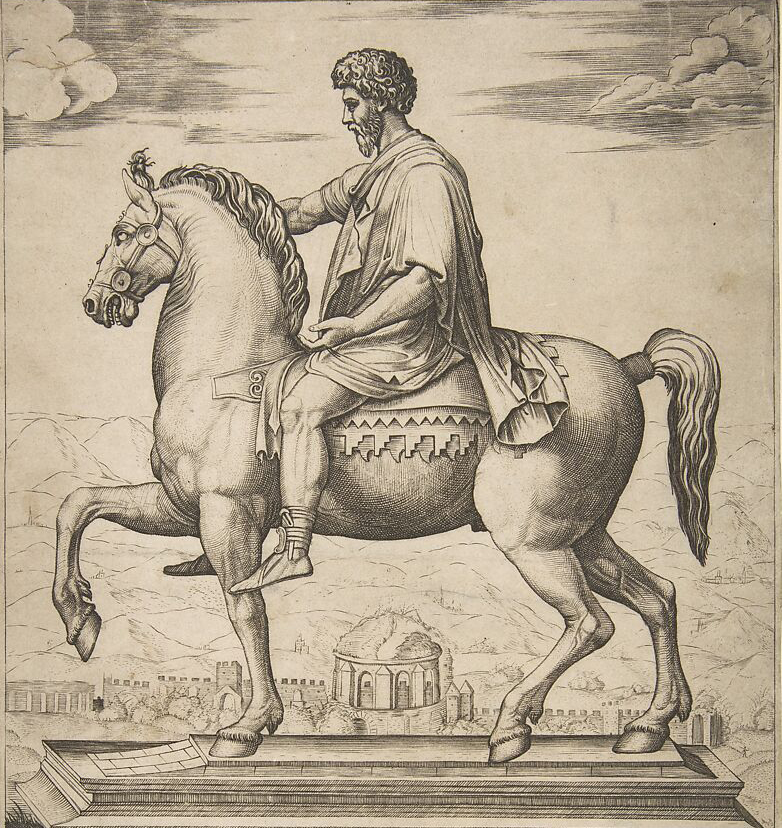
Marcus AureliusMeditations by Marcus Aurelius is a collection of personal writings by the Roman Emperor, offering profound insights into Stoic philosophy. Written as a series of reflections and exercises, it emphasizes self-discipline, rationality, and virtue as the path to a tranquil life. Aurelius contemplates the impermanence of life, urging acceptance of nature's course and the inevitability of death. He advocates for inner governance, urging individuals to master their thoughts and emotions rather than be swayed by external circumstances.
The work stresses the interconnectedness of all things, the importance of living in accordance with nature, and the value of serving others with justice and kindness. Through his meditations, Aurelius seeks to maintain personal integrity, embrace the present moment, and find peace by aligning with universal principles. His writings remain a timeless guide to living a meaningful, virtuous life amidst life's challenges.
Unable to load audio
Remember how long you have been putting off these things, and how many times the gods have given you days of grace, and yet you do not use them. Now is it high time to perceive the kind of Universe whereof you are a part and the nature of the governor of the Universe from whom you subsist as an effluence, and that the term of your time is circumscribed, and that unless you use it to attain calm of mind, time will be gone and you will be gone, and the opportunity to use it will not be yours again.
Do things from outside break in to distract you? Give yourself a time of quiet to learn some new good thing and cease to wander out of your course. But, when you have done that, be on your guard against a second kind of wandering. For those who are sick to death in life, with no mark on which they direct every impulse or in general every imagination, are triflers, not in words only but also in their deeds.
Nothing is more wretched than the man who goes round and round everything, and, as Pindar says, 'searches the bowels of the earth', and seeks by conjecture to sound the minds of his neighbours, but fails to perceive that it is enough to abide with the Divinity that is within himself and to do Him genuine service.
Of man's life, his time is a point, his existence a flux, his sensation clouded, his body's entire composition corruptible, his vital spirit an eddy of breath, his fortune hard to predict, his fame uncertain. Briefly, all the things of the body, a river; all the things of the spirit, dream and delirium; his life a warfare and a sojourn in a strange land, his after-fame oblivion. What then can be his escort through life? One thing and one thing only, Philosophy.
In all things awaiting death, with a mind that is satisfied, counting it nothing else than a release of the elements from which each living creature is composed. Now if there is no hurt to the elements themselves in their ceaseless changing each into other, why should a man apprehend anxiously the change and dissolution of them all? For this is according to Nature; and no evil is according to Nature.
Moreover, he remembers that all reasonable beings are akin to himself, and that although to care for all men is in accord with man's nature, he is to cling not to the opinion of all men, but only of men who live in accord with Nature.
But if nothing higher is revealed than the very divinity seated within you, subordinating your private impulses to itself, examining your thoughts, having withdrawn itself, as Socrates used to say, from the sense-affections, and subordinated itself to the gods and making men its first care.
Never value as an advantage to yourself what will force you one day to break your word, to abandon self respect, to hate, suspect, execrate another, to act a part, to covet anything that calls for walls or coverings to conceal it. A man who puts first his own mind and divinity, and the holy rites of its excellence, makes no scene, utters no groans, will need neither the refuge of solitude nor the crowded streets.
Always make a figure or outline of the imagined object as it occurs, in order to see distinctly what it is in its essence, naked, as a whole and parts; and say to yourself its individual name and the names of the things of which it was compounded and into which it will be broken up. What is this which now creates an image in me, what is its composition? How long will it naturally continue, what virtue is of use to meet it; for example, gentleness, fortitude, truth, good faith, simplicity, self-reliance, and the rest?
If you complete the present work, following the rule of right, earnestly, with all your might, with kindness, and admit no side issue, but preserve your own divinity pure and erect, as if you have this moment to restore it; if you make this secure, expecting nothing and avoiding nothing, but content with present action in accord with Nature and with heroic truth in what you mean and say, you will live the blessed life. Now there is no one who is able to prevent this.
Do not wander from your path any longer, for you are not likely to read your notebooks or your deeds of ancient Rome and Greece or your extracts from their writings, which you laid up against old age. Hasten then to the goal, lay idle hopes aside, and come to your own help, if you care at all for yourself, while still you may.
It remains the peculiar mark of the good man to love and welcome what befalls him and is the thread fate spins for him; not to soil the divinity seated within his breast nor to disquiet it with a mob of imaginations, but to preserve and to propitiate it, following God in orderly wise, uttering no word contrary to truth, doing no act contrary to justice. And if all men disbelieve that he lives simply, modestly, and cheerfully, he is not angry with any one of them nor diverted from the road that leads to the goal of his life, at which he must arrive, pure, peaceful, ready to depart, in effortless accord with his own birth-spirit.
Men look for retreats for themselves, the country, the seashore, the hills; and you yourself, too, are peculiarly accustomed to feel the same want. Yet all this is very unlike a philosopher, when you may at any hour you please retreat into yourself. For nowhere does a man retreat into more quiet or more privacy than into his own mind, especially one who has within such things that he has only to look into, and become at once in perfect ease.
Things do not take hold upon the mind, but stand without unmoved, and that disturbances come only from the judgement within; the second, that all that your eyes behold will change in a moment and be no more; and of how many things you have already witnessed the changes, think continually of that. The Universe is change, life is opinion.
Death is like birth, a mystery of Nature; a coming together out of identical elements and a dissolution into the same.
Which of these is lovely because it is praised or corrupted because it is blamed? Does an emerald become worse than it was, if it be not praised? And what of gold, ivory, purple, a lute, a sword- blade, a flower-bud, a little plant?
Your evil does not consist in another's governing principle, nor indeed in any change and alteration of your environment. Where then? Where the part of you which judges about evil is. Let it not frame the judgement, and all is well. Even if what is nearest to it, your body, is cut, cauterized, suppurates, mortifies, still let the part which judges about these things be at rest.
Make your passage through this span of time in obedience to Nature and gladly lay down your life, as an olive, when ripe, might fall, blessing her who bare it and grateful to the tree which gave it life.
A horse runs, a hound tracks, bees make honey, and a man does good, but doesn't know that he has done it and passes on to a second act, like a vine to bear once more its grapes in due season.
Let the performance and completion of the pleasure of the Universal Nature seem to you to be your pleasure, precisely as the conduct of your health is seen to be, and so welcome all that comes to pass, even though it appears rather cruel, because it leads to that end, to the health of the universe, that is to the welfare and well-being of Zeus.
One must console oneself by awaiting Nature's release, and not chafing at the circumstances of delay, but finding repose only in two things: one, that nothing will befall me which is not in accordance with the nature of the Whole; the other, that it is in my power to do nothing contrary to my God and inward Spirit; for there is no one who shall force me to sin against this.
I was composed of a formal and a material substance; and of these neither will pass away into nothingness, just as neither came to exist out of nothingness. Thus, every part of me will be assigned its place by change into some part of the Universe, and that again into another part of the Universe, and so on to infinity.
As are your repeated imaginations so will your mind be, for the soul is dyed by its imaginations.
Call to mind the whole of Substance of which you have a very small portion, and the whole of time whereof a small hair's breadth has been determined for you, and of the chain of causation whereof you are how small a link.
Why do the ignorant and unlearned confound men of knowledge and learning? What soul has knowledge and learning? That which knows the beginning and end and the reason which informs the whole substance and through all eternity governs the Whole according to appointed cycles.
Wait in peace, whether for extinction or a change of state; and until its due time arrives, what is sufficient? What else than to worship and bless the gods, to do good to men, to bear them and to forbear; and, for all that lies within the limits of mere flesh and spirit, to remember that this is neither thine nor in thy power.
The governing principle it is which wakes itself up and adapts itself, making itself of whatever kind it wills and making all that happens to it appear to be of whatever kind it wills.
Whenever you are obliged by circumstances to be in a way troubled, quickly return to yourself, and do not, more than you are obliged, fall out of step; for you will be more master of the measure by continually returning to it.
Surely it is an excellent plan, when you are seated before delicacies and choice foods, to impress upon your imagination that this is the dead body of a fish, that the dead body of a bird or a pig; and again, that the Falernian wine is grape juice and that robe of purple a lamb's fleece dipped in a shellfish's blood; and in matters of sex intercourse, that it is attrition of an entrail and a convulsive expulsion of mere mucus. Surely these are excellent imaginations, going to the heart of actual facts and penetrating them so as to see the kind of things they really are. You should adopt this practice all through your life, and where things make an impression which is very plausible, uncover their nakedness, see into their cheapness, strip off the profession on which they vaunt themselves. For pride is an arch-seducer of reason, and just when you fancy you are most certainly busy in good works, then you are most certainly the victim of imposture.
Some things are hastening to be, others to have come and gone, and a part of what is coming into being is already extinct. Flux and change renew the world incessantly, as the unbroken passage of time makes boundless eternity ever young. In this river, therefore, on which he cannot stand, which of these things that race past him should a man greatly prize? As though he should begin to set his heart on one of the little sparrows that fly past, when already it has gone away out of his sight. Truly the life of every man is itself as fleeting as the exhalation of spirit from his blood or the breath he draws from the atmosphere. For just as it is to draw in a single breath and to return it, which we do every moment, so is it to render back the whole power of respiration, which you acquired but yesterday or the day before, at birth, to that other world from which you first drew it in.
Wrestle to continue to be the man Philosophy wished to make you. Reverence the gods, save men. Life is brief; there is one harvest of earthly existence, a holy disposition and neighbourly acts.
All things come from that other world, starting from that common governing principle, or else are secondary consequences of it. Thus, even the lion's jaws, deadly poison, and every injurious thing, like a thistle or a bog, are by-products from those august and lovely principles. Do not, then, imagine them to be contrary to what you reverence, but reflect upon the fountain of all things.
He who sees what is now has seen all things, whatsoever came to pass from everlasting and whatsoever shall be unto unlimited time. For all things are of one kin and of one kind.
If, however, we decide that only what our will controls is good or evil, then no ground is left either to arraign God or to adopt the position of an enemy to man.
Habituate yourself not to be inattentive to what another has to say and, so far as possible, be in the mind of the speaker. What does not benefit the hive is no benefit to the bee.
Whatever anyone may do or say, I am bound to be good; exactly as if gold or emerald or purple were continually to say this: 'whatever anyone may do or say, I am bound to be an emerald and to keep the colour that is mine.
Happiness is a good genius or a good familiar spirit. 'What then are you doing here, phantom of imagination? Depart, in God's name, the way you came; I have no need of you. But you have come according to your ancient habit. I am not angry with you, only depart.'
When a man offends against you, think at once what conception of good or ill it was which made him offend. And, seeing this, you will pity him, and feel neither surprise nor anger. For you yourself still conceive either the same object as he does to be good, or something else of the same type; you are bound, therefore, to excuse him. If, on the other hand, you no longer conceive things of that kind to be goods or ills, you will the more easily be kind to one whose eye is darkened.
Wipe away the impress of imagination. Stay the impulse which is drawing you. Define the time which is present. Recognize what is happening to yourself or another. Divide and separate the event into its causal and material aspects. Dwell in thought upon your last hour. Leave the wrong done by another where the wrong arose.
Direct your thought to what is being said. Let your mind gain an entrance into what is occurring and who is producing it.
Make yourself glad in simplicity, self-respect, and indifference to what lies between virtue and vice. Love mankind. Follow God.
It is absurd that a man's expression should obey and take a certain shape and fashion of beauty at the bidding of the mind, whereas the mind itself is not shaped and fashioned to beauty by itself.
The earth-born parts return to earth again, But what did blossom of ethereal seed Returns again to the celestial pole. Or else this: an undoing of the interlacement of the atoms and a similar shattering of the senseless molecules.
Live out your life without restraint in entire gladness even if all men shout what they please against you, even if wild beasts tear in pieces the poor members of this lump of matter that has hardened about you. For, in the midst of all this, what hinders the mind from preserving its own self in tranquillity, in true judgement about what surrounds it and ready use of what is submitted to it, so that judgement says to what befalls it: 'this is what you are in reality, even if you seem other in appearance'.
Perfection of character possesses this: to live each day as if the last, to be neither feverish nor apathetic, and not to act a part.
It is ridiculous not to flee from one's own wickedness, which is possible, but to flee from other men's wickedness, which is impossible.
When you have done good and another has been its object, why do you require a third thing besides, like the foolish- to be thought to have done good or to get a return?
No one wearies of receiving benefits, and to benefit another is to act according to Nature. Do not weary then of the benefits you receive by the doing of them.
There are three relations: one to your environment, one to the divine cause from which all things come to pass for all, one to those who live at the same time with you.
Pain is an evil, either to the body, in which case let the body say that it is so, or to the soul. But it is in the soul's power to preserve its own quiet and calm, and not to judge pain to be an evil; for every judgement, impulse, desire, or aversion is within, and nothing evil makes its way up to this.
Wipe out impressions by continually saying to yourself: it is in my power now not to allow any wickedness to be in this soul of mine, any appetite or disturbance at all, but seeing what is the character of them all I employ each according to its worth. Remember this power as Nature requires.
If you suffer pain because of some external cause, what troubles you is not the thing but your decision about it, and this it is in your power to wipe out at once. But if what pains you is something in your own disposition, who prevents you from correcting your judgement? And similarly, if you are pained because you fail in some particular action which you imagine to be sound, why not continue to act rather than to feel pain? 'But something too strong for you opposes itself. Then do not be pained, for the reason why the act is not done does not rest with you. 'Well, but if this be left undone, life is not worth living? Depart then from life in a spirit of good will, even as he dies who achieves his end, contented, too, with what opposes you.
They kill you, cut you in pieces, pursue you with curses. What has this to do with your understanding abiding pure, sane, temperate, and just? As if a man should stand by a sweet and crystal spring of water and curse it, but it never ceases bubbling up in water fresh to drink, and if he throw in mud or dung, it will quickly break it up and wash it away and will in no way be discoloured. How then shall you possess an everflowing fountain, not a mere cistern? If you guard yourself every hour unto freedom, contentedly, too, simply and reverently.
He who does not know that the Universe exists, does not know where he is. He who does not know the purpose of the Universe, does not know who he is nor what the Universe is. He who fails in any one of these respects could not even declare the purpose of his own birth. What then do you imagine him to be, who shuns or pursues the praises of men who applaud, and yet do not know either where they are or who they are?
The sun appears to be poured down and indeed is poured in every direction but not poured out. For this pouring is extension, and so its beams are called rays from their being extended. Now you may see what kind of thing a ray is by observing the sun's light streaming through a chink into a darkened room. For it is stretched in a straight line, and rests so to speak upon any solid body that meets it and cuts off the flow of air beyond. It rests there and does not glide off or fall. The pouring and diffusion of the understanding then should be similar, in no way a pouring out, but an extension, and it should not rest forcibly or violently on obstacles that meet it nor yet fall down, but stand still and illuminate the object that receives it; for that which does not reflect it will rob itself of the light.
He who runs after pleasures as goods and away from pains as evils commits sin; for being such a man he must necessarily often blame Universal Nature for distributing to bad and good contrary to their desert, because the bad are often employed in pleasures and acquire what may produce these, while the good are involved in pain and in what may produce this.
Whosoever does wrong, wrongs himself; whosoever does injustice, does it to himself, making himself evil.
One vital spirit is distributed in irrational creatures: one mind spirit is divided in rational creatures; just as one element earth is in all earthy things and we see by one light and breathe one atmosphere, all that have sight and vital spirit.
All that partakes of a common mind similarly, or even more swiftly, hastens to what is akin; for in proportion as it is superior to the rest, so is it more ready to mix and be blended with its own kind. At any rate there were found from the first among irrational creatures, hives, and flocks, care for nestlings, and what resembles love.
Among the yet higher, even among beings in a sense separated, there subsisted a unity such as obtains among the stars. Thus progress towards the higher was able to produce a sympathy even in what are separated.
If you can, change him by teaching, but if you cannot, remember that kindness was given you for this. The gods, too, are kind to such men and even co-operate with them to some objects, to health, to wealth, to reputation, so good are they to men; and you may be so too; or say, who is there to prevent you?
Today I escaped all circumstance, or rather I cast out all circumstance, for it was not outside me, but within, in my judgements.
All things are the same: familiar in experience, transient in time, sordid in their material; all now such as in the days of those whom we have buried.
Things stand outside our doors, themselves by themselves, neither knowing nor reporting anything about themselves. What then does report about them? The governing self.
The ceasing of action, impulse, judgement is a pause and a kind of death, not any evil. Now pass to the ages of your life, boyhood for instance, youth, manhood, old age; for each change of these was a death; was it anything to be afraid of? Pass now to your manner of life under your grandfather, then under your mother, then under your (adoptive) father, and when you dis- cover many another destruction, change, and ending, ask yourself: ‘Was it anything to be afraid of?’ So then even the ceasing, pause, and change of your whole life is not.
Calm, in respect of what comes to pass from a cause outside you; justice, in acts done in accord with a cause from yourself: that is to say, impulse and act terminating simply in neighbourly conduct, because for you this is according to Nature.
You have the power to strip off many superfluities which trouble you and are wholly in your own judgement; and you will make a large room at once for yourself by embracing in your thought the whole Universe, grasping ever-continuing Time and pondering the rapid change in the parts of each object, how brief the interval from birth to dissolution, and the time before birth a yawning gulf even as the period after dissolution equally boundless.
All that your eyes behold will very quickly pass away, and those who saw it passing will themselves also pass away very quickly; and he who dies in extreme age will be made equal in years with the infant who meets an untimely end.
What governing selves are theirs, what mean ends have they pursued, for what mean reasons do they give love and esteem! Accustom yourself to look at their souls in nakedness. When they fancy that their blame hurts or their praise profits, how great their vanity.
It is in your power to convert the man who has gone astray, for every man who does wrong is going wrong from the goal set before him and has gone astray. And what harm have you suffered? For you will find that none of those with whom you are angry has done the kind of thing by which your understanding was likely to become worse and it is there that your ills and harms have their entire existence.
Wilt thou one day, my soul, be good, simple, single, naked, plainer to see than the body surrounding thee? Wilt thou one day taste a loving and devoted disposition? Wilt thou one day be filled and without want, craving nothing and desiring nothing, animate or inanimate, for indulgence in pleasures.
To Nature, who bestows all things and takes them away, the man who has learnt his lesson and respects himself says: 'Give what is thy good pleasure, take back what is thy good pleasure'; and this he says not boasting himself but only listening to her voice and being of one mind with her.
What creatures they are; they eat, sleep, copulate, relieve nature, and so on; then what are they like as rulers, imperious or angry and fault-finding to excess; yet but yesterday how many masters were they slaving for and to what purpose, and tomorrow they will be in a like condition.
He who runs away from his master is a fugitive slave. But law is a master and therefore the transgressor of law is a fugitive slave. In the same way, also, he who gives way to sorrow or anger or fear, wishes that something had not been or were not now, or should not be heareafter, of what is appointed by that which ordains all things; and that is law, laying down for every man what falls to his lot. He, therefore, who yields to fear or pain or anger is a fugitive slave.
Contemplate, therefore, in thought what comes to pass in such a hidden way, and see the force which makes things gravitate or tend upwards, not with the eyes, but none the less clearly.
Picture to yourself every man who gives way to pain or discontent at anything at all as like a pig being sacrificed, kicking and squealing. Such also is the man who groans on his bed, alone and in silence. Think of the chain we are bound by, and that to the rational creature only is it given to obey circumstances of his own will, while mere obedience is necessary for all.
What is the soundest thing that can be done or said in a given material condition? For whatever this may be, you are able to do or say it, and you are not to make the excuse that you are prevented. You will never cease groaning until you feel that to act appropriately to man's constitution in any material condition which occurs to you or befalls you is for you what luxury is to the sensualist. For you should regard as an indulgence whatever you can achieve in accord with your own nature, and this you can achieve everywhere.
Remember that nothing harms the natural citizen which does not harm the city and nothing harms the city which does not harm the law. Now none of what are called strokes of bad luck harms the law: wherefore, not harming the law, it harms neither city nor citizen.
The healthy eye should be able to look at every object of sight, and not to say: 'I wish it were green', for this is what a man does who has ophthalmia. The healthy ear and nose must be ready for every object of hearing or smell, and the healthy stomach must be disposed to every kind of nourishment as the mill is ready for everything which it is made to grind. Accordingly the healthy understanding too must be ready for all circumstances; but that which says: 'may my children be kept safe' or 'may all men praise whatever I do', is the eye looking for green or the teeth for what is tender.
Just as those who oppose you as you progress in agreement with right principle will not be able to divert you from sound conduct, so do not let them force you to abandon your kindness towards them; but be equally on your guard in both respects, in steady judgement and behaviour as well as in gentleness towards those who try to hinder you or are difficult in other ways. For to be hard upon them is a weakness just as much as to abandon your course and to give in, from fright; for both are equally deserters from their post, the man who is in a panic as well as the man who is alienated from his natural kinsman and friend.
The objects whose pursuit or avoidance disturbs your peace do not come to you, but in a measure you go to them. Let your judgement at all events about them be untroubled and they will remain unmoved, and you will be seen neither to pursue nor to avoid them.
The intention will reveal itself, it ought to be graven on the forehead; the tone of voice should give that sound at once; the intention should shine out in the eyes at once, as the beloved at once reads the whole in the glances of lovers.
In your angry fits have the maxim ready that it is not passion that is manly, but that what is kind and gentle as it is more human so is it more manly, and that this is the character which has strength and sinews and fortitude, not that which is indignant and displeased; for as this is nearer to imperturbability so it is nearer to power; and as grief is a mark of weakness, so also is anger, for both have been wounded and have surrendered to the wound.
Your element of spirit and all the element of fire that is mingled in you, in spite of their natural upward tendency, nevertheless obey the ordering of the Whole and are held forcibly in the compounded body in this region of the earth. Once more, all the elements of earth and of water in you, in spite of their downward tendency, are nevertheless lifted up and keep to a position which is not natural to them. In this way then even the elements are obedient to the Whole and, when they are stationed at a given point, remain there by compulsion until once more the signal for their dissolution is made from the other world.
The Pythagoreans say: Look up to the sky before morning breaks, to remind ourselves of beings who always in the same relations and in the same way accomplish their work, and of their order, purity, and nakedness; for a star has no veil.
It is in your power to secure at once all the objects which you dream of reaching by a roundabout path, if you will be fair to yourself: that is, if you will leave all the past behind, commit the future to Providence, and direct the present, and that alone, to Holiness and Justice. Holiness, to love your dispensation for Nature brought it to you and you to it; Justice, freely and without circumlocution both to speak the truth and to do the things that are according to law and according to worth. And be not hampered by another's evil, his judgement, or his words, much less by the sensation of the flesh that has formed itself about you- let the part affected look to itself.
If then, when you arrive at last at your final exit, resigning all else, you honour your governing self alone and the divine element within you, if what you dread is not that some day you will cease to live, but rather never to begin at all to live with Nature, you will be a man worthy of the Universe that gave you birth, and will cease to be a stranger in your own country, surprised by what is coming to pass every day, as at something you did not look to see, and absorbed in this thing or in that. 2 God beholds the governing selves of all men stripped of their material vessels and coverings and dross; for with His own mind alone He touches only what has flowed and
God beholds the governing selves of all men stripped of their material vessels and coverings and dross; for with His own mind alone He touches only what has flowed and been drawn from Himself into these selves. You, too, if you make it your habit to do this, will rid yourself of your exceeding unrest. For it would be strange that one who does not behold the poor envelope of flesh should yet lose his time in admiring dress and dwelling and reputation, and all such trappings and masquerade.
Consider the causes of reality stripped of their covering; the relations of your actions; the nature of pain, pleasure, death, fame; who is not the author of his own unrest; how none is hindered by his neighbour; that all things are what we judge them to be.
In the case of one who gives the impression that he did wrong, how do I know that this was a wrong? And, if he certainly did wrong, how do I know that he was not condemning himself, and so what he did was like tearing his own face? One who wants an evil man not to do wrong is like a man who wants a fig tree not to produce its acrid juice in the figs, and infants not to cry, and a horse not to neigh, and whatever else is inevitable. With that kind of disposition what else can he do? Very well then, if you are man enough, cure this disposition.
If it is not right, don't do it: if it is not true, don't say it. Let your impulse be to see always and entirely what precisely it is which is creating an impression in your imagination, and to open it up by dividing it into cause, matter, relation, and into the period within which it will be bound to have ceased.
Perceive at last that you have within yourself something stronger and more divine than the things which create your passions and make a downright puppet of you. What is my consciousness at this instant? Fright, suspicion, appetite? Some similar evil state?
First, do nothing aimlessly nor without relation to an end. Secondly, relate your action to no other end except the good of human fellowship.
A little while and you will be nobody and nowhere, nor will anything which you now behold exist, nor one of those who are now alive. Nature's law is that all things change and turn, and pass away, so that in due order different things may come to be.
All things are what we judge them to be, and that rests with you. Put away, therefore, when you will, the judgement; and, as though you had doubled the headland, there is calm, 'all smoothly strewn and a waveless bay.
Any single activity you choose, which ceases in due season, suffers no evil because it has ceased, neither has he, whose activity it was, suffered any evil merely because his activity has ceased. Similarly, therefore, the complex of all activities, which is a man's life, suffers no evil merely because it has ceased, provided that it ceases in due season, nor is he badly used who in due season brings his series of activities to a close. But the season and the term Nature assigns-sometimes the individual nature, as in old age, but in any event Universal Nature, for by the changes of her parts the whole world continues ever young and in her prime. Now what tends to the advantage of the Whole is ever altogether lovely and in season; therefore for each individual the cessation of his life is no evil, for it is no dishonour to him, being neither of his choosing nor without relation to the common good: rather is it good, because it is in due season for the Whole, benefiting it and itself benefited by it. For thus is he both carried by God, who is borne along the same course with God, and of purpose borne to the same ends as God.
First, in what you do that your act be not without purpose and not otherwise than Right itself would have done, and that outward circumstances depend either on chance or Providence; but neither is chance to be blamed, nor Providence arraigned.
Cast out the judgement; you are saved. Who then hinders your casting it out?
Whenever you feel something hard to bear, you have forgotten (a) that all comes to pass according to the Nature of the Whole, (b) that the wrong is not your own but another's, further (c) that all that is coming to pass always did, always will, and does now everywhere thus come to pass, (d) the great kinship of man with all mankind, for the bond of kind is not blood nor the seed of life, but mind. You have forgotten, moreover, (e) that every individual's mind is of God and has flowed from that other world, (f) that nothing is a man's own, but even his child, his body, and his vital spirit itself have come from that other world, (g) that all is judgement, (h) that every man lives only the present life and this is what he is losing.
How cheap is all that man strains to get, and how much wiser it were, with the material granted to you, to present yourself just, temperate, obedient to the gods in all simplicity; for pride smouldering under a cover of humility is the most grievous pride of all.
One light of the Sun, even though it be sundered by walls, by mountains, by a myriad other barriers. One common Matter, even though it be sundered in a myriad individual bodies. One vital spirit, even though it be sundered in a myriad natural forms and individual outlines. One intelligent spirit, even though it appears to be divided.
What more do you ask? To go on in your mere existence? Well then, to enjoy your senses, your impulses? To wax and then to wane? To employ your tongue, your intelligence? Which of these do you suppose is worth your longing? But if each and all are to be despised, go forward to the final act, to follow Reason, that is God. But to honour those other ends, to be distressed because death will rob one of them, conflicts with this end.
How is the governing self employing itself? For therein is everything. The rest are either within your will or without it, ashes and smoke.
This is a stirring call to disdain of death, that even those who judge pleasure to be good and pain evil, nevertheless disdain death.
For him whose sole good is what is in due season, who counts it all one to render according to right reason more acts or fewer, and to whom it is no matter whether he beholds the world a longer or a shorter time-for him even death has lost its terrors.
Mortal man, you have been a citizen in this great City; what does it matter to you whether for five or fifty years? For what is according to its laws is equal for every man. Why is it hard, then, if Nature who brought you in, and no despot nor unjust judge, sends you out of the City as though the master of the show, who engaged an actor, were to dismiss him from the stage? 'But I have not spoken my five acts, only three?' 'What you say is true, but in life three acts are the whole play. For He determines the perfect whole, the cause yesterday of your composition, today of your dissolution; you are the cause of neither. Leave the stage, therefore, and be reconciled, for He also who lets his servant depart is reconciled.
You May Also Enjoy
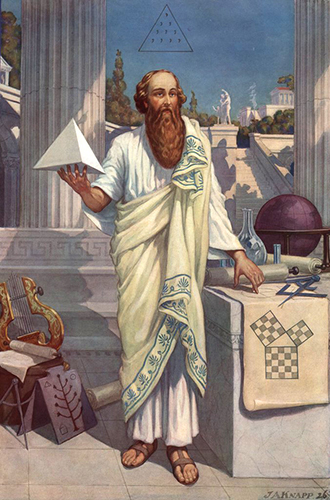
Golden Verses of Pythagoras
The Golden Verses of Pythagoras is a collection of moral exhortations that outline a path to a virtuous and fulfilling life. It emphasizes reverence for the gods, heroes, and familial respect, while encouraging friendships with virtuous individuals. Self-discipline is paramount, urging the control of passions like gluttony, sloth, and anger. Justice, reason, and self-respect are core tenets, with a call to avoid evil deeds and to act thoughtfully.
Physical health is to be maintained through moderation and a balanced lifestyle. Reflection on daily actions is recommended to foster personal growth. The text advocates for an understanding of the divine and human nature, acceptance of fate, and avoidance of unnecessary strife. By following these principles, one can attain spiritual purity, wisdom, and ultimately transcend mortal limitations, achieving a state of immortality and incorruptibility.

Elements of Theology
ProclusElements of Theology is a seminal work in Neoplatonic philosophy, composed around 450 CE. Structured as a series of 211 propositions, each accompanied by a proof, the text systematically explores the hierarchical structure of reality, beginning with the concept of the One—the ultimate principle of unity and source of all existence.
Proclus delineates the process of emanation from the One, through successive levels of reality, including the divine intellect (Nous), the World Soul, and individual souls, culminating in the material world. This framework illustrates how multiplicity arises from unity and how all entities participate in the Good.
The Elements of Theology has profoundly influenced both Eastern and Western philosophical traditions. Notably, its ideas permeated medieval thought through the Liber de Causis, an Arabic adaptation erroneously attributed to Aristotle, which was later recognized as a summary of Proclus’ work. The text remains a cornerstone for understanding Neoplatonic metaphysics and its enduring impact on subsequent philosophical and theological discourse.